
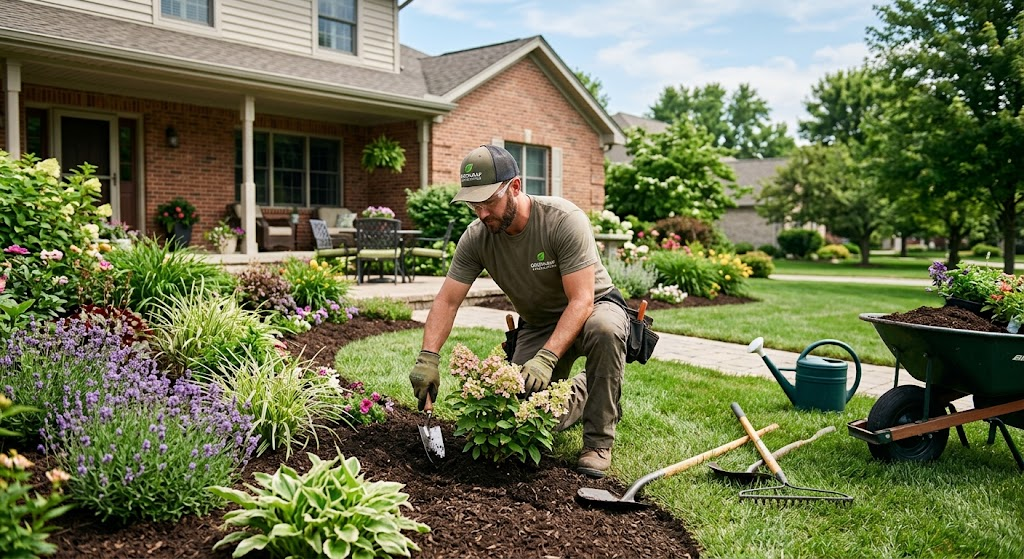
Landscaping spans two very different businesses: recurring maintenance contracts and one-off design-build projects worth twenty times as much. Search strategy should reflect which one you actually want more of.
New Jersey's lot sizes drive that split. Bergen County and North Jersey mix dense quarter-acre neighborhoods, where maintenance contracts dominate, with larger properties in towns like Saddle River and Franklin Lakes, where design-build and hardscaping budgets live. Because the towns sit so close together, the map pack changes every few miles, and the seasonal calendar — spring cleanups, summer installs, fall leaves, winter snow — resets demand four times a year.
Maintenance searches are proximity-driven and price-sensitive. Hardscaping and design-build searches are visual, aspirational, and worth building an entire portfolio strategy around — including seasonal shifts into snow removal and spring cleanups.
We are a local SEO agency working across every service industry, and this page covers how we handle landscaping search specifically.
Most of the work on a landscaping campaign runs through a handful of services: google business profile optimization for landscaping companies and reputation management for landscaping companies.
Why landscaping rankings are hard to win in NJ
Seasonality creates dead months
Landscaping demand in New Jersey resets four times a year, and without a publishing calendar built around that cycle, your site goes quiet exactly when the next season's buyers start searching. Spring cleanup searches begin in February, while sites still show winter content. Fall aeration searches begin in August, while sites still promote summer color. Each gap is a month or more of lost visibility handed to a competitor who planned ahead. Snow removal is the sharpest version of this problem — the companies that publish and update snow pages in September, before the first forecast, own that search category by November. Waiting until the first storm means competing against everyone at once for terms that already have an established local pack.
Design-build work is sold visually
Patios, retaining walls, outdoor kitchens and pergolas are researched the way kitchens and additions are: through photos, budgets and timelines, not a paragraph of service copy. A homeowner in Saddle River comparing hardscaping contractors is looking at galleries on three or four sites in one sitting, and the one with organized, well-described projects — by material, by town, by rough budget — reads as more credible even before a call happens. A rotating homepage slider with five stock-feeling photos does not rank and does not close. Individual project pages do both, because they target the specific searches homeowners run before they ever pick up the phone.
Low barriers to entry crowd the market
Anyone with a truck and a mower can call themselves a landscaper, which floods the map pack with thin, similar-looking listings and makes differentiation hard for search engines and homeowners alike. Licensing for pesticide application, insurance coverage, crew stability and equipment ownership are real differences between a stable company and a seasonal operator, but almost no one puts that information where it can influence a decision or a ranking. Pages that state these facts plainly — years in business, certifications, crew size, service radius — give both Google and the homeowner something concrete to evaluate, and they consistently outperform generic 'trusted local landscapers' copy in both trust and click-through.
How we approach landscaping SEO
Separate maintenance, design-build, hardscaping and seasonal service pages
A homeowner searching for a weekly mowing plan and a homeowner searching for a paver patio are different customers with different budgets, and one blended 'landscaping services' page serves neither well. We build dedicated pages for lawn maintenance, design-build, hardscaping, and each major seasonal service, each targeting its own keyword set and written to the buyer who actually searches it. This also lets pricing and proof points match the offer: transparent per-visit ranges on maintenance pages, project galleries and consultation calls-to-action on design-build pages.
Search example: “lawn maintenance plans Bergen County NJ”
Project pages organized by type and town with budget context
Every completed hardscaping or design-build project becomes its own page: material used, square footage, rough budget range, and the town it was built in. This turns a photo library into ranking content for searches like 'paver patio cost' and 'retaining wall contractor near me,' and it gives prospective clients in similar towns something concrete to compare their own project against. We organize these pages by project type first, then by town, so both search intents are covered without duplicating content.
Search example: “paver patio installation Franklin Lakes NJ cost”
Snow and ice management content published in early autumn
Snow removal searches spike the week of the first forecasted storm, and by then the map pack has already settled around whoever published first. We build and publish snow and ice management pages by September — service area, contract options, commercial vs. residential plans — so the page has time to establish ranking signals before demand hits. This also keeps your site active in a season when maintenance and design-build searches drop off, protecting visibility year-round instead of just April through October.
Search example: “commercial snow removal contract Bergen County NJ”
Spring content live by February, when planning searches begin
Homeowners plan spring projects — cleanups, mulching, new plantings, patio builds — well before the weather turns, often as soon as the holidays are over. Publishing spring service pages in February instead of April gives them time to rank ahead of the actual demand spike in March and April, and it captures the early planners who book first and pay full price before the season gets crowded. We treat this as a fixed part of the annual calendar, not a reactive task.
Search example: “spring cleanup landscaping Ridgewood NJ”
Reviews collected at project completion and at contract renewal
Design-build clients are asked for a review right after installation, when the result is freshest and most photogenic — this also produces reviews that mention the specific service, which helps that page's relevance. Maintenance clients are asked again at contract renewal, since a long relationship is itself a strong trust signal for a new prospect deciding between a one-time crew and a company people keep. Both streams are timed to specific business moments rather than left to chance.
Search example: “best landscaping company Wyckoff NJ reviews”
Services that drive this
Related reading
Keywords and pages we build for landscaping companies
- Lawn maintenance plansTarget search: “weekly lawn mowing service Bergen County NJ”
- Landscape design-buildTarget search: “landscape design build company North Jersey”
- Paver patio installationTarget search: “paver patio contractor near me NJ”
- Retaining wallsTarget search: “retaining wall installation cost NJ”
- Outdoor kitchensTarget search: “outdoor kitchen builder Bergen County”
- Spring cleanupTarget search: “spring yard cleanup service Hasbrouck Heights NJ”
- Fall leaf removalTarget search: “leaf removal service North Jersey”
- Snow and ice managementTarget search: “residential snow plowing contract NJ”
Maintenance contracts vs. design-build and hardscaping
These are two different businesses sharing one truck fleet, and treating them as one on your website flattens both. Maintenance searches — mowing, fertilization, seasonal cleanups — are proximity-driven and price-sensitive; homeowners compare three or four local companies and often choose based on responsiveness and a clear per-visit or seasonal rate. Those pages should lead with service area, plan tiers, and a fast quote path.
Design-build and hardscaping searches behave more like a kitchen remodel than a commodity service. The buyer is researching for weeks or months, comparing portfolios, materials and rough budgets before ever calling. Those pages need real project photography, described in enough detail to rank for specific searches, plus honest budget ranges so unqualified inquiries filter themselves out before the consultation call. Keeping these two funnels structurally separate on the site lets each one convert the buyer actually looking for it.
The four-season New Jersey calendar, including snow removal
New Jersey's landscaping demand runs on a predictable four-season cycle: spring cleanups and new installs starting in March, summer maintenance and hardscaping builds through August, fall cleanups and aeration in September and October, and snow and ice management from November through March. Each season has its own search terms and its own lead time — spring planning searches start in February, snow contract searches start in October — and a site that only updates content once a year misses most of that volume.
Building this into a publishing calendar means snow removal pages go live in early autumn, spring service pages go live in late winter, and each seasonal page gets refreshed with current-year availability rather than left stale. For crews that offer snow removal, it also means the website never fully idles in winter — a real advantage over competitors who effectively disappear from search between November and March.
Landscaping SEO: common questions
Should maintenance and design work be separated?
Yes. They attract different customers with different budgets and different research timelines, and mixing them on one page makes your site read as unfocused to both. Maintenance pages should lead with plans and pricing; design-build pages should lead with portfolio and consultation. Separating them also lets each page target its own keywords instead of competing with itself.
When should spring content be published?
By February. Homeowners start planning spring projects right after the holidays, well before the weather turns, and pages need weeks to establish ranking before the March-April demand spike. Publishing in April instead means competing for visibility during the busiest, most crowded search period of the year.
Is snow removal worth targeting?
For most crews, yes. It is one of the few services that keeps a landscaping site active and generating leads through the winter, when maintenance and design-build searches nearly disappear. Publishing snow pages in early autumn, ahead of the first storm, is what actually captures that seasonal demand.
How many project photos does a design-build page need?
Enough to tell the full story of a project: before, during key stages, and finished, ideally eight to twelve images per page with real descriptions rather than a generic caption. Volume matters less than context — a homeowner wants to understand scope, materials and rough cost, not just see pretty pictures.
Do we need separate pages for each town we serve?
Only for towns where you have real project history or a genuinely efficient service route. A thin page for every town in North Jersey dilutes your site's authority. A handful of well-built town pages tied to actual completed projects outperforms dozens of copy-paste location pages.
How does hardscaping SEO differ from lawn care SEO?
Hardscaping is closer to a home-remodeling sale: high budget, long research window, decision driven by photos and trust. Lawn care is a recurring, lower-cost, proximity-driven decision made quickly. Hardscaping pages need portfolio depth and budget transparency; lawn care pages need fast quotes and clear service-area coverage.
Let's find out where your calls are going.
Book a free 30-minute strategy call. We'll look at your Google Business Profile, your competitors, and your current visibility together — then tell you the two or three things that would matter most.
What you get on the call
- A live look at where you rank across your service area, town by town
- A teardown of the three competitors taking your calls today
- The specific profile, citation, and review gaps holding you back
- A straight answer on what's realistic and what isn't