
September 25, 2026 · 17 min read
Local search in 2026 no longer looks like ten blue links with a map on top. A query like "emergency plumber near me" can now return an AI Overview that names two or three businesses before the user ever scrolls, a Local Pack that reshuffles based on the searcher's exact position and time of day, and a Maps result set that quietly drops listings Google can't verify. Stricter entity verification (video verification for new and edited profiles, automated suspension of listings with conflicting data) means that visibility is now gated on trust before it's earned on relevance.
Here is the thesis that the rest of this guide builds on: Google doesn't rank websites in local search. It ranks verified, real-world entities. Your website, your Google Business Profile, your reviews and your listings across the web are all evidence Google uses to answer one question: is this a real business, what exactly does it do, and is it the best answer for this person, right here, right now? Google's own documentation reduces that answer to three factors: Relevance, Distance and Prominence.
If you understand how Google Ranks Local Businesses through those three lenses, every tactic below stops being a random checklist item and becomes a lever you can pull on purpose.
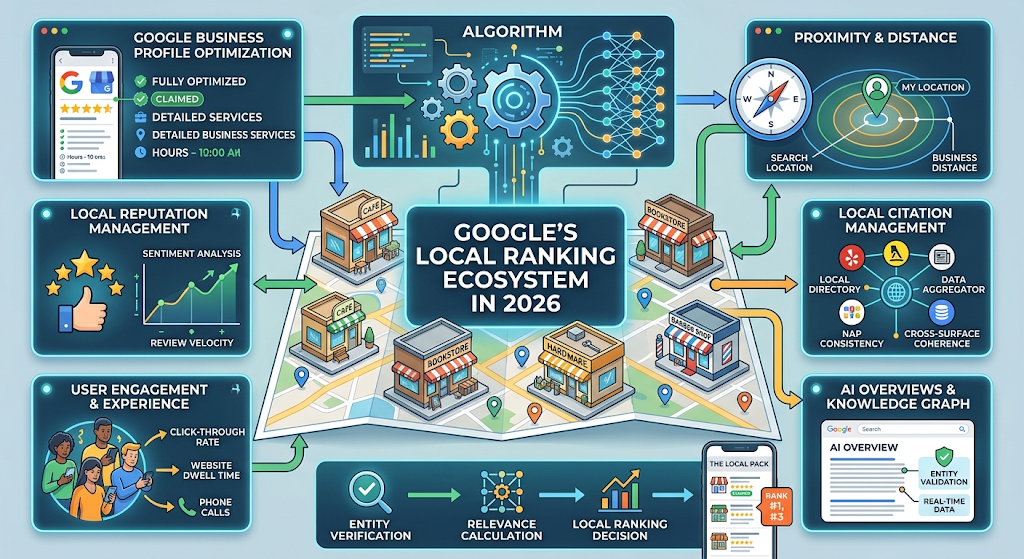
The 3 Core Pillars of Google's Local Search Algorithm
Every local result is the output of three scores computed together. You can influence two of them heavily and one of them barely at all, and knowing which is which saves months of wasted effort.
Relevance: does this entity match the query?
Relevance measures how well a business matches what the searcher means, not just the words they typed. Google infers this from your GBP primary and secondary categories, services, products, attributes, review text, and the content of your website.
- Example: A search for "gluten-free birthday cake" can surface a bakery whose categories say only Bakery, because its service list includes "custom gluten-free cakes" and 40 reviews mention it.
- What you control: Almost everything. Relevance is where most local SEO work pays off fastest.
Distance (Proximity): how close is the entity to the searcher?
Distance is calculated from the searcher's device location, or from the location named in the query ("dentist in Hoboken"). If no location is known, Google estimates it from other signals.
- Example: Two equally strong HVAC companies swap places in the Local Pack as the searcher drives from one side of town to the other.
- What you control: Very little. You cannot rank a single location across an entire metro just by optimizing harder. Fake addresses and virtual offices to "move closer" are policy violations that lead to suspension. Your real lever is widening the radius in which you are the best answer by being more relevant and more prominent than competitors near the edges.
Prominence: how well known and trusted is the entity?
Prominence reflects how established and trusted a business is, both online and offline. Signals include review count, rating and recency, links and mentions from other sites, citations, brand searches, and offline fame (a landmark museum is prominent before it posts a single photo).
- Example: A 20-year-old family law firm with coverage in the local paper, a chamber listing and 300 reviews outranks a newer firm one block closer.
- What you control: A lot, but slowly. Prominence compounds over time.
How AI Overviews pull from the Local Knowledge Graph
The Knowledge Graph is Google's database of entities (people, places, businesses) and the relationships between them. Each verified business is a node with attributes: name, category, address, hours, services, rating, and connections to other entities such as a neighborhood or a parent brand.
When an AI Overview answers a local question such as "best place for ramen open late near Journal Square," it does not read your website from scratch. It assembles an answer from entity data Google already trusts: GBP fields, review summaries, structured data and consistent third-party listings. Two practical consequences follow:
- Facts you haven't stated don't exist to the AI. If "open until 1 a.m." isn't in your GBP hours and your schema, you won't be cited for "open late."
- Conflicting facts get you dropped. If your website says one phone number and Yelp says another, the model's confidence falls and it picks a competitor whose data agrees everywhere.
The rest of this guide covers how to feed each pillar with clean, verifiable data.
Pillar 1: Advanced Google Business Profile Optimization
Your Google Business Profile (GBP) is the single highest-leverage asset in local search because it is your entity record. Google Business Profile Optimization is not about filling fields once; it is about making every field precise, verifiable and current.
Primary vs. secondary categories: the #1 relevance signal
Your primary category is the strongest relevance signal you control. It tells Google what you are. Secondary categories (up to nine) tell Google what else you do, and they carry noticeably less weight.
- Choose the most specific primary category that describes your core revenue. "Personal Injury Attorney" beats "Lawyer." "Emergency Veterinarian Service" beats "Veterinarian" if that's the business.
- Use secondary categories for real, distinct services only. A dental practice might use Cosmetic Dentist and Emergency Dental Service. Adding unrelated categories dilutes relevance and can trigger manual review.
- Audit competitors. Check the primary categories of the top three businesses in your Local Pack. If they all use a category you don't, that's usually your fastest ranking gain. If you're missing from the pack entirely, see why your business isn't showing in the Map Pack.
- Test deliberately. Change one category at a time, then track rankings with a geo-grid tool for three to four weeks before judging.
Real-world business name vs. keyword stuffing
Your GBP name must match your real-world name exactly as it appears on your signage, website and legal documents. Adding keywords ("Smith Plumbing | 24/7 Emergency Plumber Hackensack") violates Google's guidelines.
Keywords in the name still correlate with higher rankings, which is exactly why Google polices it aggressively. In 2026 the risk profile is:
- Automated spam filters compare your GBP name against your website, signage photos and third-party listings. A mismatch can trigger re-verification or a soft suspension.
- Competitor edit suggestions are processed quickly; a single "suggest an edit" from a rival can strip your keywords and flag the profile.
- The safe way to get keywords into your name is to legally register a DBA that includes them and use it consistently everywhere, including signage.
High-converting attributes, services and products
Attributes are the yes/no facts Google asks about: wheelchair accessible, women-owned, online appointments, free Wi-Fi. They feed filters in Maps and conversational queries in AI Overviews ("LGBTQ+-friendly salons near me").
- Fill every attribute that is true. Unset attributes are treated as unknown, not as no.
- Build out the Services and Products sections completely. Each service should have its own name and a 250 to 300 character description written in plain customer language, not internal jargon.
- Menus and price lists (restaurants, salons, clinics) should be entered natively in GBP, not only linked as a PDF, so Google can parse individual items.
Media upload frequency (photo and video velocity)
Fresh, original media signals an active, real business and increases engagement on your profile.
- Aim for a steady cadence, such as a few new photos every week, rather than 50 photos once a year.
- Upload real photos: storefront (helps verification and navigation), interior, team, and work in progress. Stock images add nothing and can be removed.
- Short vertical videos (15 to 30 seconds) of the space or a job being done are increasingly surfaced in Maps and mobile results.
- Name files descriptively before upload. Geotagging EXIF data has no proven ranking effect, so don't waste time on it.
GBP Q&A and Posts for conversational search
Conversational queries ("do they take walk-ins on Sunday?") are exactly what AI Overviews try to answer. Give Google the answer in your own words first.
- Seed the Q&A (where available in your market) with the 10 to 15 questions your front desk hears most, then answer them from the owner account. Keep answers short and factual.
- Use Posts weekly for offers, events, new services and seasonal updates. Posts expire from prominent display, so cadence matters more than length.
- Mirror the language customers use. If people ask for "same-day AC repair," say "same-day AC repair," not "expedited HVAC service."
Pillar 2: Local Reputation Management & Sentiment Signals
Reviews feed two pillars at once: they build prominence (trust) and they add relevance (the words customers use). Local Reputation Management is therefore a ranking discipline, not just a customer-service task.
Beyond star ratings: velocity, recency and sentiment
A 4.8 average is table stakes in competitive categories. Google looks at the shape of your review profile over time:
- Review velocity: the rate at which new reviews arrive. A steady flow (say, eight to twelve a month for a busy clinic) looks natural. Thirty in one week after two silent years looks like a campaign and invites scrutiny.
- Recency: a profile whose newest review is nine months old reads as possibly closed or declining, both to Google and to customers. Recent reviews matter more than lifetime count.
- Sentiment: the emotional tone of review text. A 4-star review that says "fast, honest, fixed our leak in an hour" carries more useful signal than a 5-star review that just says "great."
How Google's NLP parses review text for long-tail keywords
Natural Language Processing (NLP) is the branch of AI that lets software understand human language: which things are mentioned, what is said about them, and whether it's positive or negative. Google applies it to every review.
Example: A review reads, "Dr. Patel did my Invisalign consult and the whole team was patient with my anxious 8-year-old." From that one sentence, Google can extract the entity (Dr. Patel), a service (Invisalign), an audience (kids, anxious patients) and positive sentiment. That's why the practice can surface for "kid-friendly orthodontist" even though the phrase appears nowhere on its website. The same extraction powers the highlighted "place topics" and review snippets in Maps.
How to encourage keyword-rich reviews without scripting them:
- In your review request, ask a specific open question: "What service did we help you with, and how did it go?"
- Send the request right after the job, while details are fresh.
- Never supply wording or ask customers to include particular keywords. That crosses into manipulation.
The danger of review gating, fake reviews and suppression penalties
- Review gating means asking customers how they felt first and only sending happy ones to Google. It violates Google's policies, and many review platforms prohibit it outright. Ask every customer the same way.
- Fake or incentivized reviews (paid, swapped, written by staff, or rewarded with discounts) are prohibited by Google and, in the U.S., by the FTC rule on fake reviews that took effect in October 2024, which allows civil penalties.
- Algorithmic suppression: Google's systems remove suspicious reviews in bulk, and repeat offenders can receive a public warning banner on their profile and restrictions on receiving new reviews. Removal of a wave of reviews also resets your velocity and recency signals, so the ranking damage outlasts the penalty.
Best-practice review response workflow
Responding to reviews shows Google and customers that a real, active business sits behind the profile. It also gives you a place to restate services in natural language.
- Set a service level: reply to every review within 48 hours. Assign one owner and one backup.
- Positive reviews: thank the reviewer by first name, mention the specific service they received, and keep it to two or three sentences. "Thanks, Maria! Glad the same-day water heater replacement got you back to hot showers."
- Negative reviews: respond calmly, acknowledge the issue, avoid disclosing private details (critical for healthcare and legal), and move the conversation offline with a named contact.
- Fake or policy-violating reviews: flag them through Google's review management tool, document your evidence, and reply briefly and professionally in case the review stays up.
- Close the loop monthly: tag recurring complaints (wait times, pricing clarity) and fix the operational cause. Sentiment improves fastest when the underlying experience does.
Pillar 3: Local Citation Management & Cross-Surface Entity Coherence
A citation is any online mention of your business's name, address and phone number. Twenty years ago, local SEOs chased citation volume. In 2026, Local Citation Management is about Entity Coherence: every surface that describes your business (GBP, website, Apple Maps, Bing Places, Yelp, industry directories, social profiles, AI assistants) tells the same story, so Google can merge them into one confident entity record.
What NAP consistency actually means in 2026
NAP stands for Name, Address, Phone. Consistency no longer means character-for-character identical strings. Google normalizes "Street" vs. "St." and "Suite 200" vs. "#200" easily. What it cannot reconcile are factual conflicts:
- Different phone numbers across listings, often caused by call-tracking numbers used as the primary number. (Use the tracking number as primary in GBP only if your main line is added as an additional phone, and keep your website's main number consistent.)
- Old addresses that survived a move on aggregator and directory sites.
- Name variations that suggest different businesses ("Smith & Sons Plumbing" vs. "Smith Plumbing Co.").
- Mismatched hours and categories between GBP, your website and major platforms.
In 2026, think of it as NAP+W+H+C: name, address, phone, website URL, hours and category, all aligned.
Structured citations vs. unstructured local mentions
Structured citations are business listings in a fixed format on directories and data platforms: Yelp, Apple Business Connect, Bing Places, Facebook, BBB, industry directories, and data aggregators such as Data Axle and Foursquare, which syndicate your data to hundreds of downstream sites and apps.
Unstructured local mentions are references to your business inside normal content: a feature in the local newspaper, a chamber of commerce member spotlight, a sponsorship thank-you on a youth league site, a local blogger's roundup.
| Metric | Structured Citations (Yelp, Apple Maps, Data Aggregators) | Unstructured Local Mentions (Local News, Chamber of Commerce) |
|---|---|---|
| Primary role | Verifies entity facts (NAP, hours, category) | Builds prominence, context and topical association |
| Indexing Weight | High for data validation; low incremental value once the core platforms are clean | Variable; high when the source is authoritative and local, often with a followed link |
| Entity Impact | Increases Google's confidence that your entity is real and accurately described; errors actively hurt | Strengthens prominence and relevance ("trusted roofer in Bergen County"); rarely causes harm |
| Effort to acquire | Low to moderate; claim, correct, maintain | Moderate to high; requires PR, partnerships, community involvement |
| Priority order | First: fix the core 10 to 20 platforms and aggregators | Second: pursue continuously once data is clean |
How duplicates and inconsistent data destroy entity confidence
Google's goal is to maintain one node per real business in its Knowledge Graph. Conflicting data breaks that:
- Duplicate GBP profiles (often created by a previous owner, an old agency, or Google auto-generating a listing from aggregator data) split your reviews and signals between two entities. Neither ranks as well as one consolidated profile would. Request removal or merging through GBP support, providing proof of the correct listing.
- Inconsistent addresses after a move can cause Google to show the old location, attach your reviews to the wrong place, or suspend the profile pending re-verification. If that happens, follow our Google Business Profile suspension recovery process.
- Practitioner and department listings (doctors, lawyers, real estate agents) need deliberate handling: individual practitioner profiles are allowed, but they must be set up correctly so they don't cannibalize the main practice listing.
On-Page Local SEO & Technical Infrastructure
Your website is the corroborating evidence behind your GBP. When Google sees the same services, location and facts on a fast, well-structured site, its confidence in your entity rises, and your GBP website link becomes a strong relevance signal on its own.
Creating high-intent local service pages
One generic "Services" page cannot rank for ten different services. Build one page per core service, and for multi-location businesses, one page per location.
A high-intent service page should include:
- A specific title and H1: "Emergency Water Heater Repair in Hackensack, NJ," not "Our Services."
- Proof of local presence: the neighborhoods or towns you actually serve, local project examples, photos from real jobs, and team members customers will meet.
- Answers to pre-purchase questions: pricing ranges or how pricing works, response times, warranties, licensing and insurance.
- Reviews that mention that service, embedded or quoted with permission.
- A clear conversion path: click-to-call button, booking link and short form above the fold on mobile.
Avoid doorway pages: dozens of near-identical "[Service] in [Town]" pages that swap only the town name. Google treats these as spam. A service-area page earns its place only if it contains genuinely local, unique content.
Embedded maps and localized content silos
- Embedded Google Map: place it on your contact page and location pages, generated from your actual GBP listing (search your business in Google Maps, then Share → Embed). It's a user-experience feature and a consistency cue, not a ranking hack.
- Localized content silos: organize the site so related content links together. Example structure: /locations/hackensack/ links to /locations/hackensack/drain-cleaning/ and /locations/hackensack/water-heaters/, and each service page links back to its location hub. This makes the relationship between place and service explicit to crawlers.
- LocalBusiness schema: add JSON-LD structured data (template at the end of this article) on your homepage or each location page. JSON-LD (JavaScript Object Notation for Linked Data) is a block of code that states your business facts in a machine-readable format, so Google doesn't have to infer them from your prose.
Core Web Vitals impact
Core Web Vitals are Google's user-experience metrics: Largest Contentful Paint (loading, target under 2.5 seconds), Interaction to Next Paint (responsiveness, target under 200 ms) and Cumulative Layout Shift (visual stability, target under 0.1).
They are a modest ranking factor on their own, but local searchers are overwhelmingly on mobile and in a hurry. A service page that takes six seconds to load on a phone loses the call to the competitor in the next Local Pack slot, and those lost engagement signals feed back into prominence over time.
- Compress and lazy-load images, especially large hero photos.
- Limit third-party scripts such as chat widgets, heatmaps and multiple tracking pixels.
- Test the pages that matter most (service and location pages) in PageSpeed Insights using field data, not just the homepage.
Conclusion & Action Plan
Understanding how Google Ranks Local Businesses comes down to one idea: be the most clearly defined, consistently described and genuinely trusted entity for what you do, where you do it. Relevance is earned through precise Google Business Profile Optimization and focused service pages. Prominence is earned through disciplined Local Reputation Management and real community presence. And Local Citation Management keeps the whole picture coherent enough that Google, and the AI Overviews built on top of it, will vouch for you.
Start with this 5-step checklist this week:
- 1. Audit and fix your GBP categories. Confirm your primary category is the most specific match for your core revenue, compare it against the top three Local Pack competitors, and remove irrelevant secondary categories.
- 2. Complete every GBP field. Fill all true attributes, list every service with a plain-language description, enter menus or price lists natively, and upload five new real photos.
- 3. Launch a review request and response workflow. Send every customer the same review request within 24 hours of service, ask what service you provided, and reply to every review within 48 hours.
- 4. Clean your core citations. Check NAP, website, hours and category on Apple Business Connect, Bing Places, Yelp, Facebook, your top industry directory and the major data aggregators; fix conflicts and request removal of any duplicate profiles.
- 5. Ship one high-intent service page with schema. Build a dedicated page for your highest-value service, add LocalBusiness JSON-LD and FAQ schema (below), and check its mobile Core Web Vitals.
Re-measure rankings with a geo-grid tracker four weeks after these changes, then repeat the cycle monthly.
Schema Markup (JSON-LD) Ready for Insertion
Paste each block inside a <script type="application/ld+json"> tag in the page's <head>, replace every placeholder in square brackets, and validate with Google's Rich Results Test and the Schema Markup Validator before publishing. Change @type to the most specific subtype of LocalBusiness that fits (for example Dentist, Plumber, Restaurant, LegalService).
1. LocalBusiness Schema
{
  "@context": "https://schema.org",
  "@type": "[Plumber]",
  "@id": "https://www.[yourdomain].com/#localbusiness",
  "name": "[Exact Business Name as on GBP and Signage]",
  "description": "[One or two sentences describing your core services and service area.]",
  "url": "https://www.[yourdomain].com/",
  "logo": "https://www.[yourdomain].com/images/logo.png",
  "image": [
    "https://www.[yourdomain].com/images/storefront.jpg",
    "https://www.[yourdomain].com/images/team.jpg"
  ],
  "telephone": "+1-[555]-[555]-[5555]",
  "email": "[info@yourdomain.com]",
  "priceRange": "[$$]",
  "address": {
    "@type": "PostalAddress",
    "streetAddress": "[123 Main Street, Suite 200]",
    "addressLocality": "[City]",
    "addressRegion": "[State Abbreviation]",
    "postalCode": "[ZIP Code]",
    "addressCountry": "US"
  },
  "geo": {
    "@type": "GeoCoordinates",
    "latitude": [40.0000],
    "longitude": [-74.0000]
  },
  "hasMap": "https://maps.google.com/?cid=[YourGoogleMapsCID]",
  "areaServed": [
    { "@type": "City", "name": "[Primary City]" },
    { "@type": "City", "name": "[Secondary City]" }
  ],
  "openingHoursSpecification": [
    {
      "@type": "OpeningHoursSpecification",
      "dayOfWeek": ["Monday", "Tuesday", "Wednesday", "Thursday", "Friday"],
      "opens": "08:00",
      "closes": "18:00"
    },
    {
      "@type": "OpeningHoursSpecification",
      "dayOfWeek": "Saturday",
      "opens": "09:00",
      "closes": "14:00"
    }
  ],
  "sameAs": [
    "https://www.facebook.com/[yourpage]",
    "https://www.instagram.com/[yourhandle]",
    "https://www.linkedin.com/company/[yourcompany]",
    "https://www.yelp.com/biz/[your-business-slug]",
    "https://maps.apple.com/?[your-apple-maps-listing]",
    "https://www.bbb.org/[your-bbb-profile]"
  ]
}2. FAQPage Schema
This block mirrors the FAQ section on this page word for word. If you edit a question or answer on the page, update it here too; Google expects FAQ markup to match visible content.
{
  "@context": "https://schema.org",
  "@type": "FAQPage",
  "mainEntity": [
    {
      "@type": "Question",
      "name": "How does Google rank local businesses in 2026?",
      "acceptedAnswer": {
        "@type": "Answer",
        "text": "Google ranks local businesses on three factors: relevance (how well the business matches the search), distance (how close it is to the searcher or the location in the query), and prominence (how well known and trusted it is). In 2026, Google also verifies that a business is a real, consistent entity before ranking it, using its Google Business Profile, reviews, citations and website data."
      }
    },
    {
      "@type": "Question",
      "name": "What is the most important Google Business Profile ranking factor?",
      "acceptedAnswer": {
        "@type": "Answer",
        "text": "The primary category is the most important relevance factor you control. It tells Google what your business is. Choose the most specific category that matches your core service, then support it with accurate secondary categories, complete services, real photos and steady reviews."
      }
    },
    {
      "@type": "Question",
      "name": "Do keywords in review text help local rankings?",
      "acceptedAnswer": {
        "@type": "Answer",
        "text": "Yes, indirectly. Google uses natural language processing to understand the services, features and sentiment mentioned in reviews, which helps your business appear for related long-tail searches. Ask customers what service you provided and how it went, but never script their wording or offer incentives for reviews."
      }
    },
    {
      "@type": "Question",
      "name": "How long does it take to improve local rankings?",
      "acceptedAnswer": {
        "@type": "Answer",
        "text": "Fixes to your Google Business Profile, such as changing the primary category or correcting data, can affect rankings within days to a few weeks. Citation cleanup typically takes four to twelve weeks to be reflected. Prominence built through reviews, links and local mentions compounds over several months."
      }
    },
    {
      "@type": "Question",
      "name": "Can I rank in a city where I don't have a physical address?",
      "acceptedAnswer": {
        "@type": "Answer",
        "text": "You can rank for searches made from or about nearby areas, but distance limits how far a single location can reach. Service-area businesses can set service areas in their profile, but using a virtual office or fake address to appear in another city violates Google's guidelines and risks suspension. Strong service pages and higher prominence are the legitimate ways to extend your reach."
      }
    }
  ]
}
Author Bio
Dan Powers is the Founder & CEO of Pwr Up Digital, a local SEO service helping service businesses across New Jersey get found by the people already searching for what they do. He spent over two decades in SEO, including as VP of Product at TMP Worldwide, before starting Pwr Up Digital in 2022. Dan personally handles strategy calls for every client — book a free audit here.