
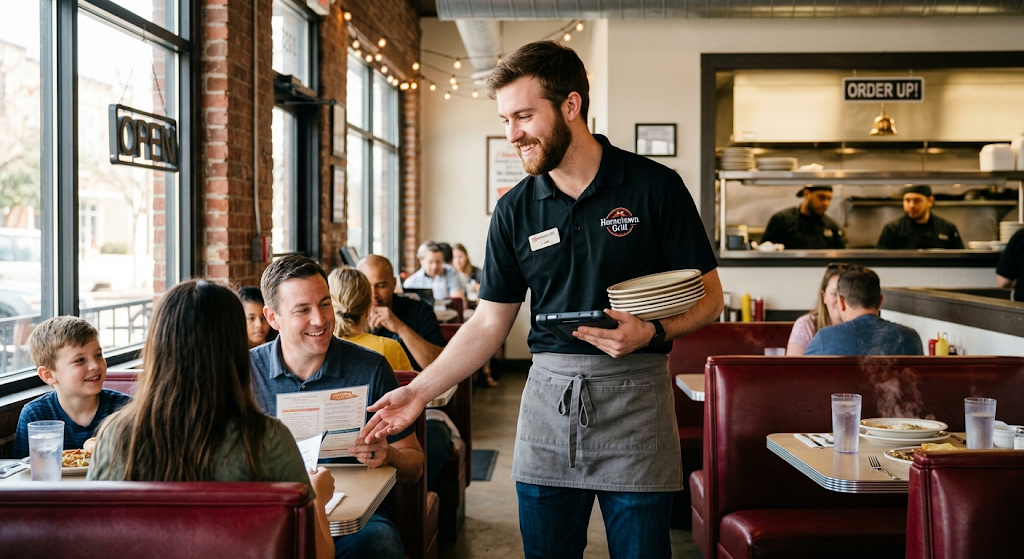
Restaurant discovery has almost entirely moved into the map and into AI-generated recommendations. Diners search 'best Italian near me', check photos, scan recent reviews, and pick — usually without opening a website at all.
New Jersey's downtowns make that competition intensely local. Bergen County towns each have their own main street, and a diner searching in Ridgewood rarely sees results from Hackensack even though it is minutes away. North Jersey's BYO culture, Sunday retail closures in parts of Bergen County and heavy commuter traffic all shape when and how people search, which is why hours, photos and menu text carry so much weight here.
The website still matters, but mostly as the source of truth Google and assistants read: a crawlable menu, correct hours, reservation links and structured data. The profile and the photos do the persuading.
We are a local SEO agency working across every service industry, and this page covers how we handle restaurant search specifically.
Most of the work on a restaurant campaign runs through a handful of services: google business profile optimization for restaurant companies and reputation management for restaurant companies.
Why restaurant rankings are hard to win in NJ
PDF and image menus are invisible
Search engines cannot reliably read them, which removes your dishes from every dish-level search. A diner searching 'best chicken parm Ridgewood' will never find your restaurant if that dish only exists inside a PDF or a scanned photo, because there is no text there for Google to index. Real HTML text with dish names, descriptions and prices is the only reliable way to show up for the exact searches your best dishes could otherwise win, and it is one of the simplest fixes on a restaurant website.
Third-party platforms intercept traffic
Delivery apps and review portals outrank restaurants for their own dishes unless the profile and site are properly maintained. Someone searching your restaurant's name plus a dish often lands on a delivery app listing instead of your site, where you pay a commission on top of losing control of the presentation. Keeping your own site and Google Business Profile current, with accurate menu text and hours, gives you a better shot at owning that search result yourself.
Photo quality is the whole first impression
Profile photography drives more decisions in this category than any other local vertical. Diners scroll photos before they read a single review, and a handful of dark, blurry or outdated photos can cost you a booking before your food is ever considered. A recurring photo program covering dishes, the dining room and seasonal specials keeps that first impression current and gives Google fresh content to associate with your listing.
How we approach restaurant SEO
HTML menu pages with dish names, descriptions and prices as real text
We build your menu as an actual web page with real text, not a PDF upload or a photo of the printed menu. Every dish name, description and price is written directly into the page, so search engines can index each item and match it to dish-level searches. This also makes the menu readable on mobile without pinching and zooming, which is how most diners look at it before deciding where to eat.
Search example: “best chicken parm Ridgewood NJ”
Menu and Restaurant schema so dishes and hours can be surfaced directly
We add structured data marking up your menu items, prices, hours and restaurant details, so search engines and AI-driven assistants can surface specific dishes and accurate hours directly in results without needing to guess at them. This is the technical layer underneath the crawlable text that helps your dishes actually appear in dish-specific and 'open now' searches.
Search example: “Italian restaurant open now Bergen County”
A recurring photo program covering food, room and seasonal specials
We set up a repeatable schedule for uploading fresh photos of dishes, the dining room and seasonal specials to your Google Business Profile and website. Recency and volume of photos both correlate with stronger local visibility in this category, and seasonal specials give a natural, ongoing reason to add new images every few weeks rather than letting the profile go stale.
Search example: “restaurants with outdoor seating near me”
Review responses on every review, especially the critical ones
We write or template responses to every review your restaurant receives, with particular care on critical ones, since prospective diners read those responses to judge whether a complaint reflects a pattern or a one-off. A thoughtful, non-defensive response to a bad review often does more to build trust than another five-star review would.
Search example: “restaurant reviews Hackensack NJ”
Event, catering and private-dining pages that capture high-value bookings
We build dedicated pages for catering, private dining and event bookings, since these searches carry much higher order values than a single dinner reservation and are frequently underserved on restaurant websites. A clear page describing packages, minimums and how to inquire captures this business before a prospect calls a competitor instead.
Search example: “restaurant private party room Bergen County”
Keywords and pages we build for restaurant companies
- Full menu (HTML)Target search: “menu with prices near me”
- Dish-specific landing contentTarget search: “best chicken parm Ridgewood”
- Hours and locationTarget search: “restaurant open now near me”
- ReservationsTarget search: “make a reservation Hackensack restaurant”
- CateringTarget search: “restaurant catering Bergen County”
- Private dining / eventsTarget search: “private party room restaurant near me”
- Happy hourTarget search: “happy hour specials near me NJ”
- Outdoor seatingTarget search: “restaurants with outdoor seating Bergen County”
Your menu has to be real, crawlable text
Your menu has to be built as real, crawlable HTML text, not a PDF or a photo of the printed menu. Search engines index text. They cannot reliably read the words inside a PDF layout or a scanned image, no matter how nicely it's designed, which means every dish on that menu is functionally invisible to search.
That invisibility has a direct cost. A diner searching for a specific dish, a dietary option like 'gluten free pasta near me', or a price point never reaches your restaurant in the results, because there is no indexable text connecting your site to that search. Meanwhile a competitor with a plain HTML menu page shows up for exactly that search.
This is also why this section of your website content reads as plain text with no images required to make its point: the words themselves are what search engines and readers both need, and a well-written paragraph does the job a graphic cannot. We build your menu the same way, as real text, with dish names, descriptions and prices typed directly into the page rather than embedded in a file or image.
Restaurant SEO: common questions
Do we still need a website?
Yes, as the authoritative source for menu, hours and reservations. Even when diners never visit it, search engines and AI assistants read it to answer questions like 'does this restaurant have a gluten free menu' or 'is this place open on Sundays', which shapes what shows up before a diner ever opens your site.
How often should photos be updated?
Monthly at minimum. Recency is a visible freshness signal and seasonal dishes give you a natural cadence. Restaurants that let their profile photos sit unchanged for a year typically look less active than competitors uploading new dishes and dining-room shots regularly.
Is it worth responding to every review?
Yes. Prospective diners read the responses to decide whether a bad review reflects a pattern or a one-off. A calm, specific response to a critical review often reassures a new diner more effectively than adding another positive review would.
Why can't we just use our existing PDF menu?
Because search engines cannot reliably read text inside a PDF or scanned image, which means every dish listed there is invisible to dish-specific searches. Converting the menu to real HTML text is one of the highest-impact, lowest-cost fixes available to most restaurant websites.
Do delivery apps hurt our search visibility?
They can, if your own site and Google Business Profile are thin or outdated, since a delivery platform's listing may outrank your restaurant for its own dish or brand name. Keeping your own menu, hours and photos current gives you a better chance of owning that search result instead of losing the click and the commission.
What pages matter most beyond the menu?
Hours, reservations and, if applicable, catering or private dining. These pages capture high-intent searches, particularly catering and events, which carry higher order values than a single table reservation and are often missing entirely from restaurant websites.
Let's find out where your calls are going.
Book a free 30-minute strategy call. We'll look at your Google Business Profile, your competitors, and your current visibility together — then tell you the two or three things that would matter most.
What you get on the call
- A live look at where you rank across your service area, town by town
- A teardown of the three competitors taking your calls today
- The specific profile, citation, and review gaps holding you back
- A straight answer on what's realistic and what isn't